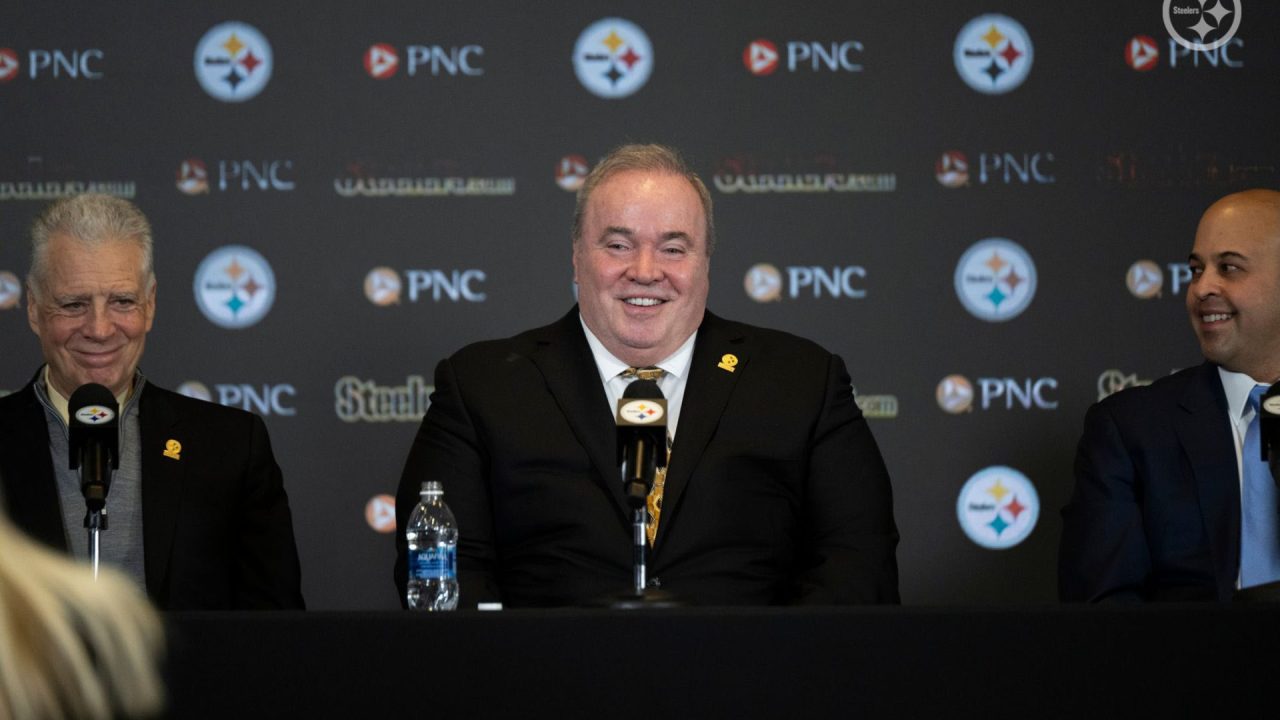
Photo: steelers.com
The Pittsburgh Steelers officially introduced Mike McCarthy as the 17th head coach in franchise history on Tuesday, and the longtime NFL coach delivered an emotional, detailed, and forward‑looking session that laid out exactly how he plans to lead the team into its next era. From his connection to Pittsburgh to his vision for the roster, staff, and quarterback room, McCarthy made it clear he’s stepping into the job with purpose and a plan.
Here are the biggest takeaways from his first day on the job.
McCarthy said his year off was centered around family, a contrast to his 2019 sabbatical, which he treated like a full football season. He still studied league trends and game management from afar, but the time away ultimately refreshed him and reaffirmed his desire to return.
McCarthy described the interview process as a natural fit, citing instant alignment with Art Rooney II and Omar Khan — a connection strengthened by their shared history in New Orleans 25 years ago. Rooney and Khan said they entered the search with an open mind, but McCarthy’s résumé and fit made the decision clear. McCarthy emphasized his belief in a family‑driven locker room culture and said the emotional response to his hiring has been overwhelming as he focuses on assembling his coaching staff.
McCarthy made it clear he plans to coach for a long time, joking about “dog years” but emphasizing how energized he feels by the challenge of today’s NFL. He spoke emotionally about the moment he shared the news with his parents, calling the last 72 hours “overwhelming” and “surreal,” with more messages than he received after winning the Super Bowl. At the core of it all, he said he still loves the daily grind — the players, the game‑planning, the competition — and wasn’t ready to walk away from coaching.
McCarthy praised the roster’s strong foundation, especially the defensive core and the long‑standing 3–4 identity he’s admired for years. He emphasized continuity on that side of the ball, saying the existing structure and terminology should be preserved and built upon.
“I love the roster… It’s a great group of men, just based off the feedback. We all talk to each other, and so I’m really looking forward to moving the needle with those guys… Like I said, Mike Tomlin and Omar, they’ve left me with a lot to work with. I feel good about the direction. I’m really excited about the defense…
The history of the Steelers defense and staying with the 3-4 is important, as far as the origin of it. That’s something we have to build off of… I’ve been a head coach for 18 years. I’ve had one top 5 defense, and we won the Super Bowl that year. The importance of defense is critical.”
Offensively, he outlined a flexible, quarterback‑friendly approach rooted in West Coast principles but adaptable to personnel — starting with a committed run game and receivers who can line up at all three spots to create matchup advantages:
At the end of the day, you’ll never hear me say this because, I would never say we run the West Coast offense. If your system of football cannot take in every player that Omar [Khan] and Art [Rooney II] want to bring to the Pittsburgh Steelers, then you need to take a look at your system. So, we need to make sure we can accommodate the variety of players that are available to us.
McCarthy reaffirmed his long‑standing reputation as a quarterback developer, crediting early mentorship under Paul Hackett and emphasizing old‑school fundamentals, efficiency, and technique — even as modern QB play shifts toward mobility and designed runs. He believes playoff football still demands pocket passing and disciplined footwork.
McCarthy made it clear he wants Aaron Rodgers back but understands veterans need time to decompress, noting he’s already spoken with him:
“Definitely. I don’t see why you wouldn’t. But just like anything, knowing Aaron long enough, going through seasons, I think when players… when guys are up there at that stage of their career, they need to step away and decompress.
The game is so emotional. With what these men commit to, what they put into it, I think that time away is important. I have spoken to Aaron. So that’s really where we are there. I was able to sit back and watch the games, watched most of the Pittsburgh games on TV, and I thought he was a great asset for the team.”
At the same time, he expressed real excitement about working with Will Howard after his late surge at Ohio State, and said he’s eager to coach Howard and Mason Rudolph as part of a fully developed quarterback room.
McCarthy confirmed he’ll run the offense and call plays, noting that building a coaching staff has become far more complex than earlier in his career.
“Definitely. I will call the plays on offense and obviously will run the offense. But these coaching staffs, it’s a bigger challenge each and every year. I think there’s more moving parts to it. But it’s been very fluid the last 48 hours.”
He outlined the type of assistants he’s targeting — a mix of seasoned experts, potential holdovers, innovative young voices, and hard‑working grinders who fit together as a cohesive unit. With staff construction taking priority, McCarthy said he hasn’t begun deep draft work yet, and timelines for Aaron Rodgers’ decision haven’t been discussed.
McCarthy didn’t spend time rehashing the Steelers’ playoff drought. Instead, he reframed the conversation entirely: the goal isn’t simply getting into the postseason — it’s building a team that can stay there:
“Honestly, I don’t think you can really look at it that way. You know, every season’s different. Every team you coach is different. Your beliefs and your standards and the culture you’re trying to create, you’re trying to move that forward. Most important thing about playoff football is staying in the playoffs.”
He pointed to league‑wide trends showing that nearly every playoff game now comes down to the final series, the fourth quarter, or a two‑minute drill. Because of that, he believes teams must intentionally train for those moments throughout the year.
With limited practice time under modern NFL rules, McCarthy said coaches have to be deliberate about where they invest reps, and for him, that means emphasizing end‑of‑game execution, momentum swings, and situational mastery.